
Community
U.S. Mint releases Gettysburg Address quarter rolls, bags for 250th anniversary
By Leila Ahmed
Advertisement · Why this ad?
A graduate of the University at Buffalo, Leila has spent five years in journalism, previously working at a community-focused news outlet in Rochester, NY. She specializes in uncovering the diverse voices and cultural richness of Syracuse’s neighborhoods, bringing their stories to light.
More from Leila →
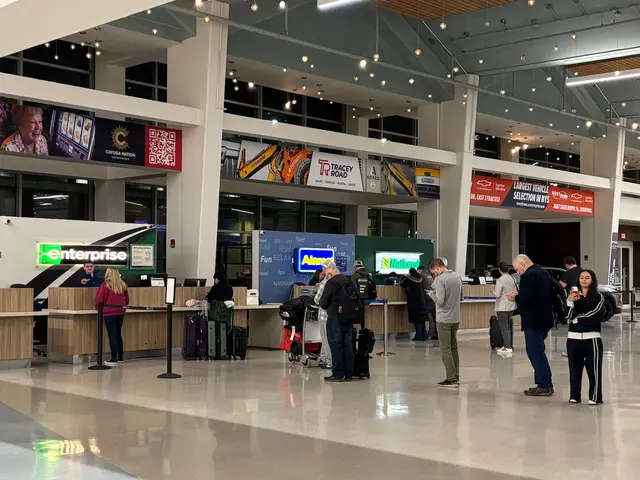
The sudden stillness that fell across American skies Friday afternoon, as the Federal Aviation Administration (FAA) issued a nationwide ground stop, was a jarring reminder of how fragile our interconnected systems can be. While the FAA has since lifted the order, halting all departing flights across the U.S., the ripple effects are sure to be felt by Syracuse families and travelers for days to come. More than 10,000 flights were disrupted as airlines dealt with delays and cancellations, leaving countless passengers stranded and travel plans in disarray – a stark contrast to the promise of reliable transportation that underpins so many American dreams.
The unprecedented ground stop, announced Friday afternoon, stemmed from “extraordinary circumstances” – communications problems at regional air traffic control centers. This meant no planes were permitted to depart from any U.S. airport until the issue was resolved. The FAA’s action was the first nationwide grounding since January 2023, when a key computer system malfunctioned, and the last time was after the September 11, 2001, attacks. While flights within Alaska and Hawaii, along with some international flights departing U.S. airspace, were initially cleared to proceed, the vast majority of domestic flights were halted. Homeland Security Secretary Markwayne Mullin stated there was “no indication” the problem stemmed from a “nefarious attack,” instead attributing it to a “major engineering defect” in an outdated system.
According to Secretary Duffy, the U.S. air traffic control system, reliant on an “incredibly old” analog system, was overwhelmed with data. “This is an emergency,” he declared, urging Congress to provide emergency funding for upgrades. At the time of the ground stoppage, 3,500 airplanes were already in the sky, with fewer than 400 in the airspace, highlighting the potential for significant congestion once operations resumed. The FAA says airplane departures can resume after the agency lifted a nationwide ground stop caused by communications problems. JetBlue canceled all remaining domestic flights Friday evening, while Air Canada canceled flights between the U.S. and Canada, impacting travelers across the continent.
Microsoft clarified that the FAA’s issues were unrelated to a separate service disruption impacting Outlook and other services that occurred Thursday, seeking to dispel misinformation. Europe’s aviation agency suspended U.S.-bound departures for its 42 member countries until midnight, further compounding the travel chaos. As of 5:50 p.m. Eastern, Cirium, an aviation analytics company, reported that 600 flights had been diverted, with many rerouted to Chicago O’Hare International Airport, Denver International Airport, Dallas Fort Worth International Airport and Ronald Reagan Washington National Airport. Approximately 11,000 flights carrying more than 1.5 million passengers were scheduled to depart U.S. airports after 4 p.m. Eastern, raising the likelihood of further delays and cancellations.
The ground stop created chaos for numerous sports teams, leaving athletes and fans stranded. Multiple NBA, NHL, and college teams were caught off guard by the sudden disruption, throwing a busy weekend of games and travel into disarray. The ripple effect extended beyond professional athletes, impacting families and individuals who had planned to attend games or travel for recreational purposes. This highlights the interconnectedness of our communities and how a single event can disrupt even the most carefully laid plans, impacting families’ treasured time together.
The immediate reaction from travelers was understandably frustration and uncertainty. While officials sought to reassure the public that no lives were at risk, the inconvenience and disruption to travel plans were significant. Secretary Mullin acknowledged the internet’s role in spreading conspiracy theories, emphasizing that “There was never any lives at risk.” Former U.S. Transportation Secretary Pete Buttigieg briefly referenced the freeze in air transportation at the start of a convention for Democrats in Denver, humorously offering to help people rebook flights. The National Weather Service quickly clarified that its radar and website were fully operational, correcting false reports of communication disruptions.
The FAA has lifted the ground stop, but the process of returning to normal operations will be slow and deliberate. Secretary Duffy cautioned that “it’s going to be slow” to get air traffic back on track, and airlines are bracing for continued disruptions throughout the weekend. JetBlue anticipates disruptions will continue into Saturday, including additional cancellations. Air Canada is also continuing to cancel flights between the U.S. and Canada. FedEx, the world’s largest cargo airline, is monitoring the situation and advising customers to track their shipments online.
The incident underscores the urgent need for modernization of the U.S. air traffic control system. Secretary Mullin estimated that a complete overhaul would cost approximately $50 billion, highlighting the significant investment required to address the system’s vulnerabilities. Congress will likely face pressure to prioritize funding for these upgrades, and the incident is sure to fuel debate about the balance between technological advancement and the potential risks of relying on outdated infrastructure. The White House has scheduled a briefing with Secretary Mullin and Secretary Duffy to provide further updates on the situation.
What unfolded Friday afternoon wasn’t just an inconvenience for travelers; it was a stark reminder of our dependence on systems we often take for granted. The fragility of these systems, particularly those vital to our economy and personal connections, should prompt a moment of reflection. We celebrate the American dream of opportunity and connection, but that dream is built on reliable infrastructure. While I am grateful that officials acted with caution and emphasized that no lives were at risk, the incident highlights the importance of prioritizing long-term investment in our nation’s essential services. It’s a sobering thought that a system reliant on technology from decades past is still guiding airplanes across our skies. Perhaps this is an opportunity for families to discuss the value of resilience and adaptability – qualities that are essential not just for navigating travel disruptions, but for facing life’s unexpected challenges. Strong marriages and families are built on these very qualities - the ability to weather storms together, and to find strength in commitment.
The situation also raises questions about the potential for cyberattacks on critical infrastructure. While officials have stated there is no indication of malicious activity in this instance, the incident underscores the importance of robust cybersecurity measures to protect our nation’s vital systems. It's a reminder that we must remain vigilant and proactive in safeguarding the infrastructure that supports our daily lives.
For Syracuse residents planning future travel, it’s wise to remain flexible and prepared for potential disruptions. Checking flight statuses regularly and allowing extra time for airport procedures are prudent measures. And perhaps, most importantly, let’s remember to appreciate the privilege of travel and the interconnectedness that makes our world so accessible – even when those connections are temporarily disrupted.
The FAA’s response to this crisis will be closely watched, and the coming weeks will likely see increased scrutiny of the nation’s air traffic control infrastructure. The hope is that this disruption serves as a catalyst for meaningful change, ensuring safer and more reliable air travel for all Americans.
Syracuse, New York
Community
Saturday, November 14, 2026
5 min
By Leila Ahmed
By Leila Ahmed

By Leila Ahmed
By Leila Ahmed